

TL;DR
AI will not create much value if companies simply lay it on top of the way work already gets done.
The advantage will come from giving people and systems trusted context, clear decision rights, live connections, and a way to learn from results.
Leaders can start now with one recurring workflow, one owner, a few trusted sources, and a review date.
The tools are getting better fast. But will your company get better with them?
In 1997, while I was still in high school, I took a cab after classes to Red Bank, New Jersey. My father had a retail store there. I went door to door telling other local retailers they should start selling online.
Most looked at me like I was the grim reaper. Fun times.
I remember vividly walking into a Halloween costume store. The owner heard me out, then gave me the “wise man” look.
“Nobody will ever buy clothing online,” he told me. “People need to touch it and feel it. Shopping is an experience.”
We know how that turned out.
He wasn’t stupid. In 1997, he probably understood the customer standing in front of him better than I did. He couldn’t imagine that customer behaving differently.
I hear a version of the same argument from business leaders today.
Nearly every leader I know believes AI will matter. Ask how Monday morning changes for a frontline employee, however, and the answer gets fuzzy fast.
Companies are buying tools, launching pilots, building dashboards, and letting people spin up apps while they burn through tokens (read: cash).
Some of this is useful. Some is expensive theater.
An NBER working paper based on nearly 6,000 senior executives found that 69% of firms actively use AI. Yet 89% reported no productivity impact over the prior three years (revenue per employee), and more than 90% reported no headcount impact.
I don’t take that to mean AI is overhyped. It tells me buying software is easy and changing a company is hard.
The work has to close a loop:
What did we know when we made a decision?
What did we assume?
What did we do?
What happened?
What changes next time?
Most companies never close the loop. They make a call, move on, and forget why. If half their decisions worked and half did not, they could not tell you which was which. So they keep “shipping,” one step forward and one step back, working harder without getting smarter.
AI can help prevent that. It can record the decision, revisit it later, compare the outcome with what the company expected, and apply the lesson to the next decision.
I really don’t care if everyone has a chatbot open all day. I care whether one decision leads to learning that makes the next one better.
Many leaders will want to form an AI committee or crowdsource ideas internally. Don’t. You cannot delegate the design of how your company will work.
The CEO and leadership team don’t need to write code. They do need to decide what the system running the business should know, where it can act, where a person has to make the call, and how the company will learn from what happens next.
That work belongs to leadership. The companies that get this right will be designed by leaders who understand the business well enough to rethink how it operates and are willing to get involved in the details.
So what does that look like on Monday morning?
Here are ten changes I expect, and what leaders can start building toward now.
1. Work will start with context, not a blank chat
Most AI work today begins with someone explaining the same situation again and again.
Open a new chat. Upload a few files. Retell the company history. Explain the client. Correct what the model misunderstood. Repeat next week.
If the work repeats, give it a permanent home.
ChatGPT Projects keeps chats, source files, and project instructions together. Claude Projects has a project knowledge base and standing instructions that apply across its chats.
Build the project around a real part of the business: a client, a product, a weekly business review, a hiring process, or a sales pipeline.
For a client renewal, it should already contain the contract, goals, account history, current performance, prior decisions, open risks, and the rules for what the team can offer without approval.
A folder of documents isn’t enough. The system needs to know which source is current, what is a fact, what is an assumption, and what changed last week.
A good prompt may save someone ten minutes. A good project keeps five people from retelling the same account history next Tuesday.
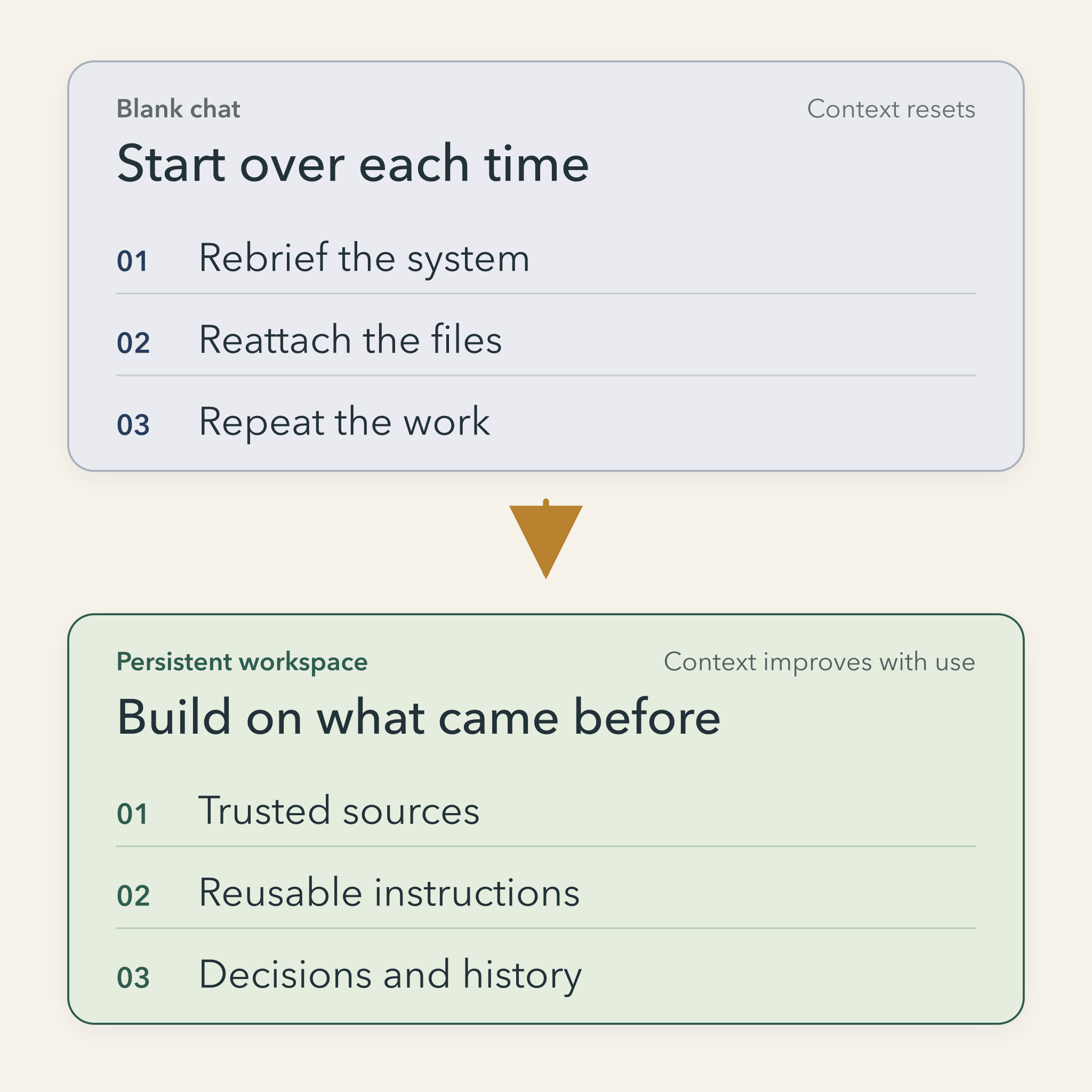
A simple goal: stop starting over.
2. Company context will become somebody’s job
At most companies, context is nobody’s job.
It lives in slide decks, inboxes, software systems, meeting notes, and people’s heads. That has always been inefficient. Once AI starts making recommendations or taking action, it becomes risky.
AI needs a brain. Not one enormous folder containing every file the company has ever created. A small, organized set of files that explains what the company knows, what it has decided, and how it works.
Start with the company brain. It should contain the current strategy, priorities, targets, customer promises, decision rules, and lessons from what the company has already tried.
Then build smaller brains for a client, product, department, or project. Each adds the context needed for that work, while staying connected to the company brain.
People can also build a brain around their own role. A sales manager might keep proven proposals, account-planning instructions, call notes, and recurring workflows in one place. That helps the individual move faster, but it should still be guided by the company and client brains. Personal context can add detail. It should not create a competing version of the truth.
The structure can be simple. For a client renewal, I would rather have four boring files than one 80-slide deck:
Current State: the facts that matter now
Decision Rules: what the team can and cannot do
Open Questions: what is missing or uncertain
Decision Log: what was decided, why, and what happened
These can be Markdown files, Google Docs, tables, or documents stored in a ChatGPT or Claude Project. The format matters less than the separation. Facts should not be mixed with instructions. Open questions should not look like settled decisions. Old policies should not quietly compete with current ones.
Coding tools already work this way. Codex uses files like AGENTS.md, while Claude Code uses CLAUDE.md for standing instructions. Ignore the technical names. Write down what you keep having to explain.
Every brain needs an owner. Someone has to decide which sources are current, resolve conflicts, control access, and remove information that is no longer true.
Otherwise, the company brain becomes another junk drawer.
The problem is rarely a shortage of information. It is that five versions exist and nobody knows which one won.
3. Strategy will show up in everyday decisions
Most strategy sits too far away from the decisions it is supposed to shape.
A leadership team says it wants to move upmarket. Six months later, the sales team is still discounting small deals because nobody translated the strategy into choices they can use.
A proposal, product decision, hiring plan, budget, or client response shouldn’t depend on whether someone remembers what was said in a meeting.
Leaders still have to make the hard choices: where the company is going, which customers it will serve, what it will be best at, and what it will refuse to do.
Then write those choices in a form people and systems can use.
Which customers are a priority?
What will we not sell?
When can price move?
Which exceptions require approval?
Put the answers into the project instructions and the Decision Rules file. Make the proposal, budget, or hiring plan check them before it reaches a leader.
A meeting deck is a terrible operating system.
4. Reports will have to lead somewhere
Your people are not short on data. The problem is getting from the data to a decision in less than 84 years.
Once a workspace has the company brain, it can compare performance with the plan and produce a short decision brief:
What changed, and why does it matter?
What is a fact, and what is an assumption?
What is missing?
What decision needs to be made, and who owns it?
I would rather get one high-quality decision than 20 insights to admire.
If a report cannot show its sources and lead to a decision, it has no place in an operating review.
5. The workspace will connect to live company systems
Your company already has the data. It is just scattered across systems that rarely talk to one another.
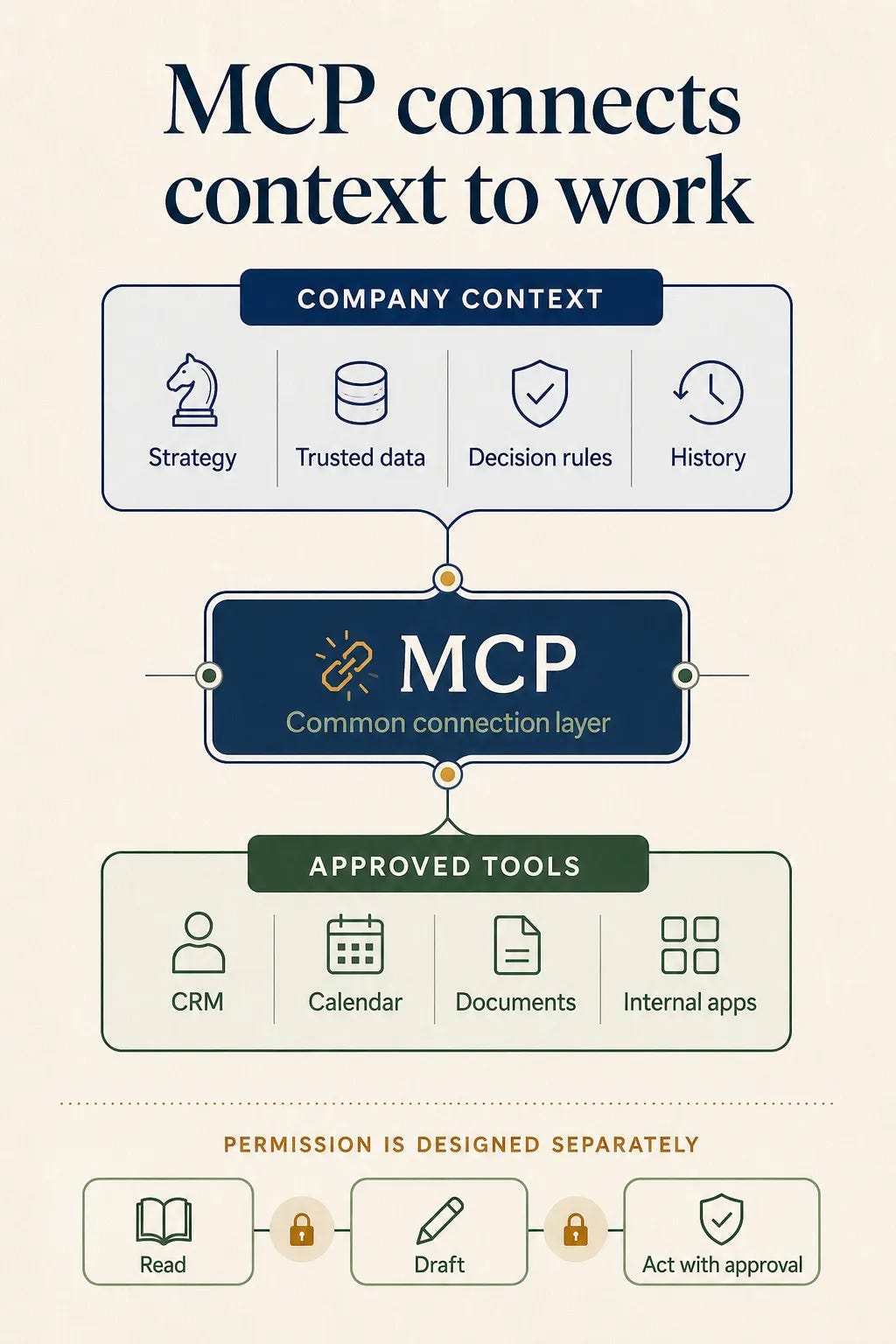
Model Context Protocol, or MCP, is an open standard that gives AI applications a common way to connect to data, tools, and workflows. With the right connections in place, internal AI workspaces can access a company’s CRM, calendar, documents, financial data, support platform, and internal applications, giving employees a more complete and current view of the business.
For employees, that means working from current company data instead of stale presentations, manual uploads, and whatever someone remembers from the last meeting.
The bigger opportunity is combining that proprietary data with outside signals. Competitor surveillance, customer reviews, economic data, market research, and category trends can all add context.
A manufacturer can make a better production decision when it sees current orders and inventory alongside supplier lead times, commodity prices, and shifts in market demand.
But connecting more data is not enough. It has to be structured so the workspace knows what is current, which sources are authoritative, what belongs to which customer or product, and what is a fact versus an assumption.
The company brain gives the information meaning. MCP keeps it connected to the live sources.
Now the workspace can flag a production risk, show what is driving it, and prepare options before someone spends half the day pulling reports and reconciling the numbers.
Of course, connecting a system does not mean everyone should be able to see everything or that AI should be free to act. You still need clear rules about access and approval. I’ll come back to that.
6. Every decision will be measured against the eventual result
Most companies are good at making decisions and terrible at going back to see whether they were right.
Every meaningful decision should record:
What was decided
Why it was decided
What result was expected
Who owns the action
When the company will check what happened
Say a manufacturer decides to reduce production because orders are slowing and inventory is rising. The expected result is lower inventory without creating stock shortages. The company agrees to check again in four weeks.
When that date arrives, the workspace can pull the latest data and ask:
Did the company act?
Did inventory fall?
Were customers still able to get what they needed?
Which assumptions were right?
What should change next time?
A calendar reminder or CRM task is enough to start. Over time, AI can handle more of this follow-up automatically.
It’s all about closing the loop.
Without that follow-up, decisions disappear into the next busy week. With it, the company turns what happened into a better next decision. They will grow faster.
7. Every decision will have a level of human control
The future is not full automation or no automation. It is giving a system the right amount of authority for each decision.
The useful question is not, “Can AI do this?”
It is, “Should AI act, ask for approval, or only advise?”
I use a tree to make that decision.
Leaf decisions can be automated. They are routine, low risk, easy to check, and easy to reverse. For example, schedule the follow-up, route the request, update the record, or reorder a standard supply within an approved range.
Branch decisions can be partially automated. The system can do the analysis and prepare the action, but it must stay within clear boundaries or ask for approval. If an order is 20% above plan, a price changes unexpectedly, or an exception falls outside policy, the system stops and brings in a person. Regardless, in all cases, a human needs to be made aware of branch decisions.
Trunk decisions require human judgment. They affect strategy, reputation, significant money, people, or commitments that are difficult to reverse. Changing a primary supplier, entering a new market, or closing a business line belongs at the trunk. AI can assemble the evidence and challenge the thinking. A person must always decide.
To place a decision on the tree, ask:
What happens if the system is wrong?
How easily can the decision be reversed?
Are the data and rules clear?
Does the decision require judgment, trust, taste, or a meaningful commitment?
The answer will be different for every company. A $5,000 decision may be a leaf at one business and a trunk at another.
These rules can be built directly into an AI or agentic workflow. Define which sources it can use, what actions it can take, where the limits are, when it must stop, who approves an exception, and what gets recorded.
Over time, a decision may move down the tree as the company gains evidence that the system handles it well. If conditions change or mistakes increase, move it back up.
Every workflow still needs a human owner. The goal is to keep your best people out of the leaves so they have time for the trunk.
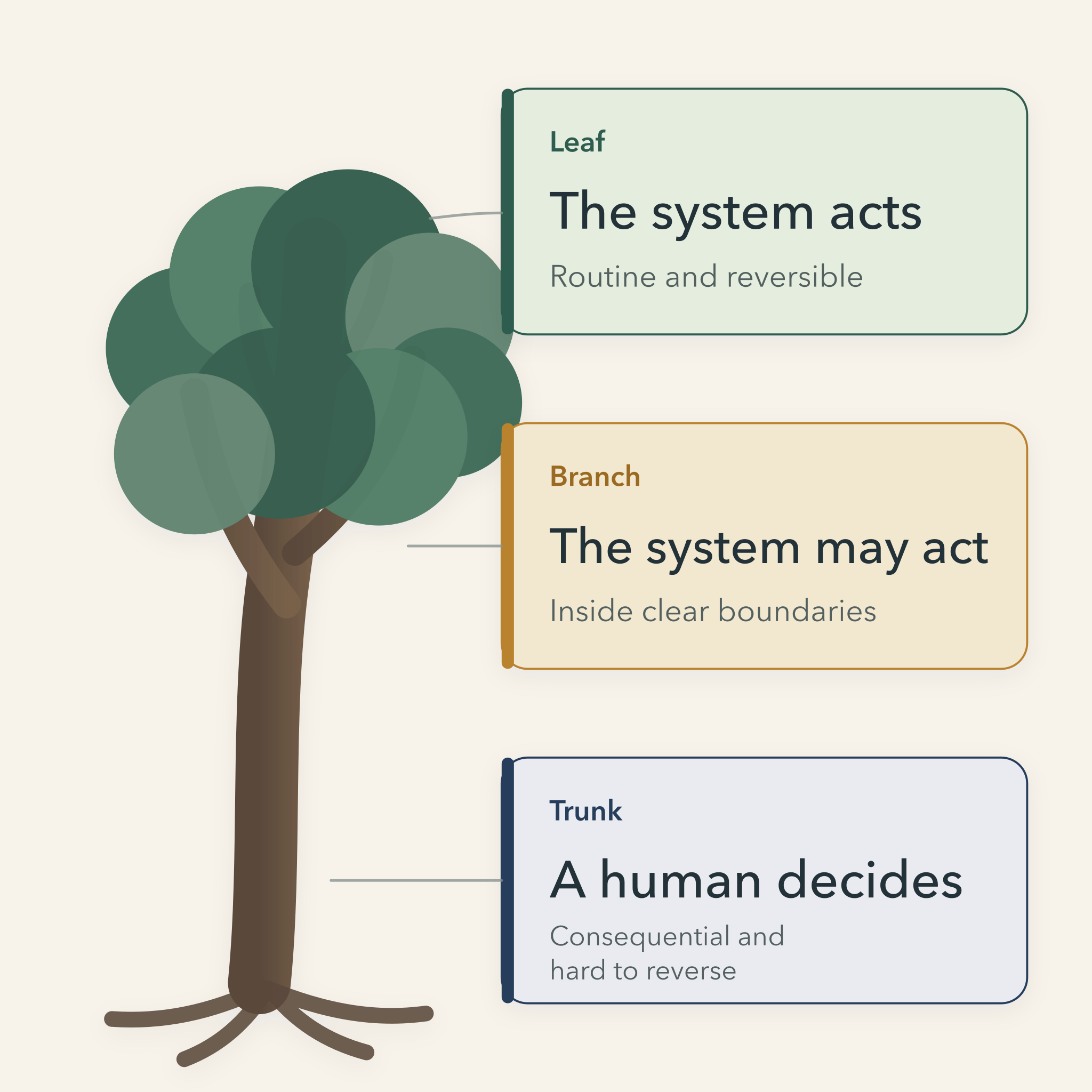
Match the level of automation to the cost of being wrong.
8. Building software will get easy. Keeping it working will stay hard.
More people will be able to describe an idea in plain English and turn it into working software.
Lovable can build a full-stack web application from natural-language instructions, including the front end, back end, database, authentication, and integrations.
It’s easy getting version one to work. Keeping version one working six weeks later is a different story.
The data changes. A user does something you did not expect. A login breaks. An update creates a problem nobody is monitoring.
Month six tells you whether you built software or a demo.
Lovable has security tools that scan code, dependencies, database rules, and access controls. Lovable’s own docs say those tools do not replace a thorough security review.
If an app matters, name an owner.
That person owns the result, data, security, testing, monitoring, failures, maintenance, and retirement.
The app may take an afternoon to build. The responsibility may last for years.
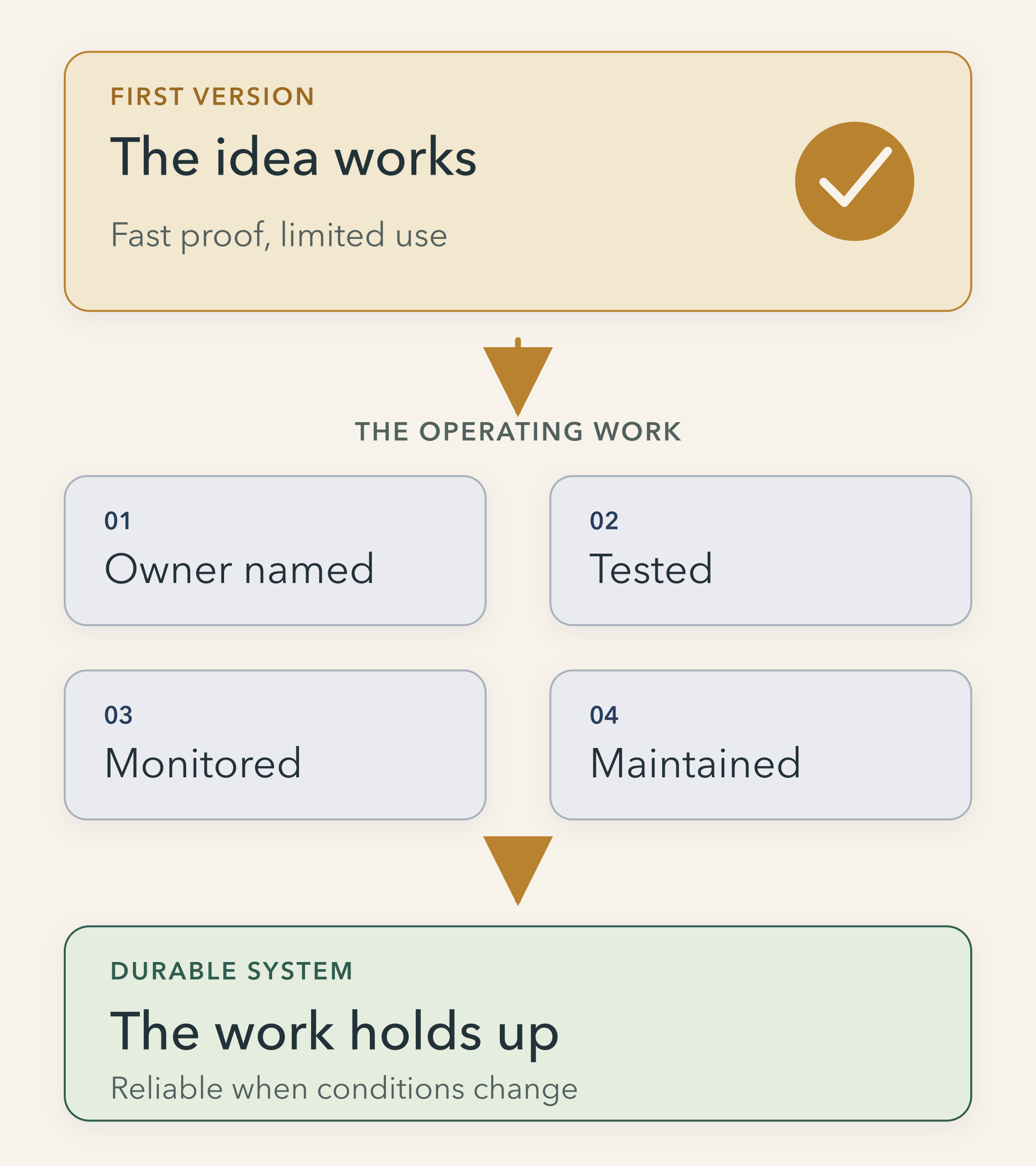
The work after launch is what makes the app durable. Poor planning, and poorly governed data sources, however, are a good way to sabotage the effort.
9. People will manage specialized agents
People won’t work with one generic assistant that does every job the same way.
A finance agent should be conservative and evidence-driven. A product agent should challenge assumptions. A compliance agent should be cautious and know when to stop. A sales agent should understand the company’s positioning, pricing rules, customer history, and approval limits.
Give 300 people a blank agent and no shared rules, and you get the wild beast.
Coding tools show where this is headed. Codex (ChatGBT) subagents can split work among specialized agents and collect their results. Claude Code subagents can have their own instructions, tools, permissions, and context.
When this moves into finance, sales, and operations, the rules cannot stay in somebody’s head. Each agent needs a defined job, approved sources, decision rights, an owner, and an escalation path.
In a P&G experiment with 776 professionals, individuals using AI matched the performance of teams without it. They also produced ideas that better balanced technical and commercial thinking.
AI can give one person some of the range that used to require a larger team. The person still has to challenge the recommendation, make the tradeoffs, and own the call.
10. The result of one decision will improve the next
Your competitors will be able to buy the same models.
The harder thing to copy will be a system that turns customer history, leadership judgment, decisions, and results into a better next call.
Established companies should have an advantage. They have years of relationships, decisions, mistakes, and scar tissue. Most of it is trapped in email, slide decks, disconnected systems, and people’s heads.
One company makes renewal decisions from memory. Another records why it thought an account was at risk, what it tried, what happened, and what it learned.
After 100 renewals, those companies won’t be in the same place.
How quickly can your company notice a change, make a call, act, see what happened, and update the way it works?
Start with one real workflow
Don’t begin with an enterprise AI strategy.
That is how you end up with a committee, a deck, twelve pilots, and token burning guaranteed to crush any vibe.
Pick one consequential workflow that happens often: a weekly business review, client renewal, product-priority decision, hiring process, or sales-pipeline review.
Name one owner and run it this way for 30 days.
Set up a project in ChatGPT Projects or Claude Projects. Add three to five trusted sources, not the entire company drive.
Create four short files:
Current State: the facts that matter now
Decision Rules: what the company will and will not do
Open Questions: what is missing or uncertain
Decision Log: what was decided, why, and what happened
They can be Markdown files, documents, or a structured table. Use the format your team will maintain.
Write down the outcome you want, who owns the call, what the system can do without approval, the expected result, and the review date.
Then give the workspace a job:
“Using only the trusted sources in this project, identify the most important decision we need to make this week. Separate facts from assumptions. Tell me what changed, what is missing, and what you recommend. Do not take action without approval.”
Record the decision, the action, the expected result, and what happened.
On the review date, update the context, rules, or workflow. Then run it again.
You will learn more from one workflow with a result than from twelve good demos.
The Halloween costume store owner did not need a five-year ecommerce strategy.
He needed to question one assumption: that customers would keep shopping the same way.
Most leaders already believe AI will matter. The dangerous assumption is that they can lay it on top of the same meetings, reports, systems, and decision process and somehow get a different company.
Your company will use AI.
Whether all that use adds up to a company that learns is a leadership decision you cannot hand off.