

In 2012, a large part of our business relied on understanding Google’s search algorithm. Overnight, Google changed it. What had been a strong, growing company suddenly lost its footing.
Revenue pressure grew. Clients were anxious. Payroll was looming. We just bought our first house. My first kid was on its way. And for the first time, I didn’t know what to do. But I knew we had to do it quickly.
I took a day off and went to the Boston Public Library. I sat in the courtyard with a blank sheet of paper and drew a line down the middle.
On the left, I listed what I actually valued as a business leader.
On the right, I wrote what my actions suggested I valued.
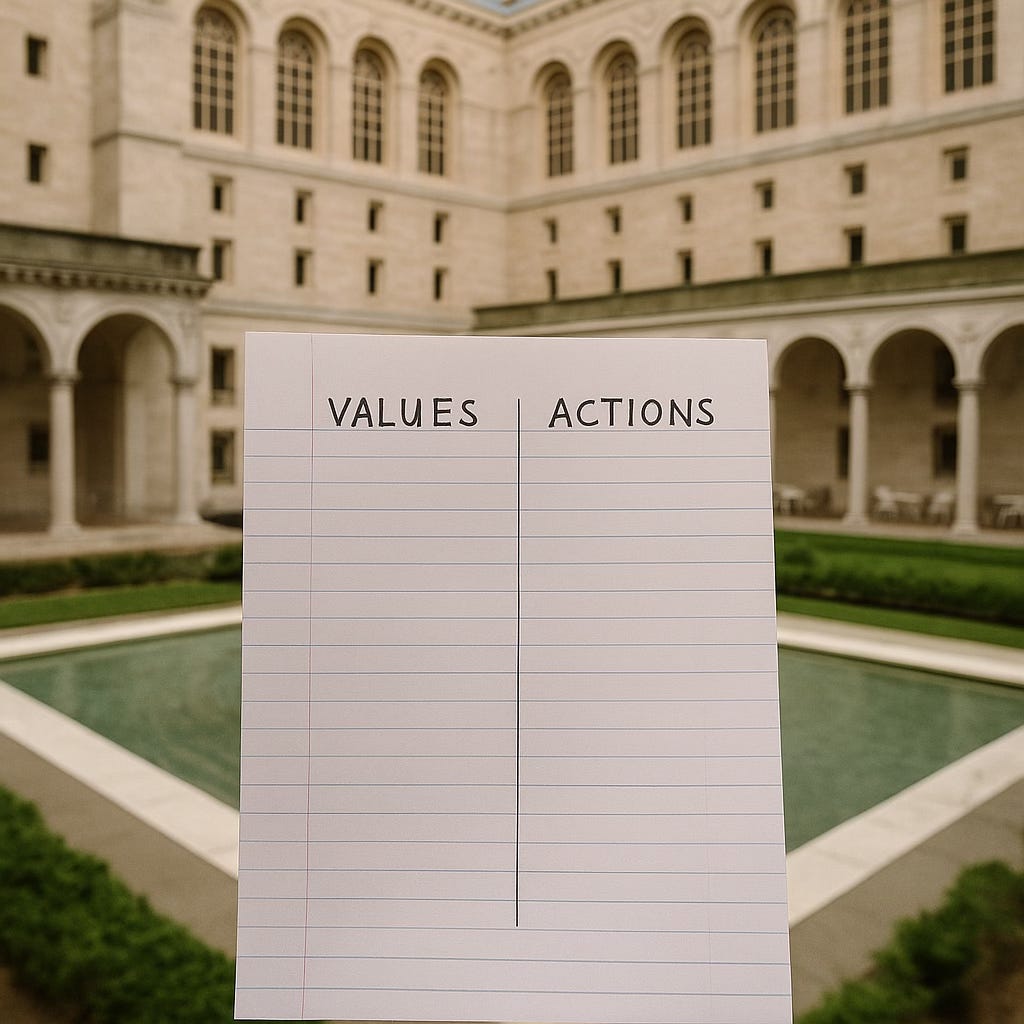
The lists didn’t match.
What I wanted: to help people and businesses truly grow, to build something evergreen, to work with data and truth, to avoid easy answers.
What I was doing: chasing short-term results, optimizing around the algorithm, building a business that could be upended by a single change.
That afternoon changed the way I led my business.
I committed that every action in the company had to align with the values on that left-hand column. It wasn’t about words. It was about setting a standard, minimizing bureaucracy, and maximizing speed to quality.
Ultimately it was about building a business that had integrity, which as I define it, means behaving in accordance with your values.
That decision became the foundation for how we rebuilt. Instead of reporting tools, we built a data platform that could plug into any application, surface insights, and guide decisions across channels. It took longer (especially because we scrapped v1), but it fueled a decade of fast growth.
I knew building that data platform would be expensive, but I didn’t want to raise outside capital and risk losing control of that vision, so we built an operation overseas. Not as a cost center, but as a modern workplace where people could thrive and give back to their community. A true win / win (one of our core values).
The company not only survived Google’s shift. It grew to become the largest independent marketing agency specialized in ecommerce.
All of that came from getting clear on what I valued and aligning my (and my company’s) actions to it.
When leaders act out of alignment, it looks like they’re moving fast, always busy, always in motion, but they’re not leading their people, and they’re not building leverage. Every decision is ad hoc. Every debate repeats itself.
The company becomes a group of people playing different games.
Some value growth.
Some value cash in hand.
Some value prestige.
Some value control.
They can’t move together because they aren’t anchored to the same framework.
When values are real, speed follows.
People trust each other.
They understand the trade-offs.
They don’t need constant supervision or reassurance.
Years later, when COVID first hit, those same principles guided how I led.
Our eCommerce clients started pausing services. I’d watch a news alert about a state shutting down, and then see the cancellations come in. It was unsettling.
My instinct wasn’t to hide it. It was to tell the truth.
And I could, thanks to the data platform we had built.
Every morning, I posted the prior day’s numbers to the entire company... how many clients paused, how much revenue we lost, and how our client’s revenue was trending across every industry vertical and channel. It was uncomfortable. It made me nervous.
But it was consistent with one of our core values: truth.
A client and friend once told me, “Action conquers fear.”
Sharing those numbers was my action.
People didn’t panic. They rallied.
They trusted the information because they saw both the good and the bad.
And as the numbers improved, the trust deepened.
The groundwork of defining values and aligning behavior to them may feel academic. It’s the work people want to skip when they’re busy. But it’s the job of the architect.
A business without that foundation might still grow for a while. But it will always work harder than it should, and it will crack under stress.
Early founders often think they’re too small to bother.
Established companies think they’re too busy to reset.
They’re both wrong.
The time to define your values, and align your actions to them, is always now.
Scott